Is WHOIS Privacy Worth It? What's Free and What's Worth Paying For
 Bret Siers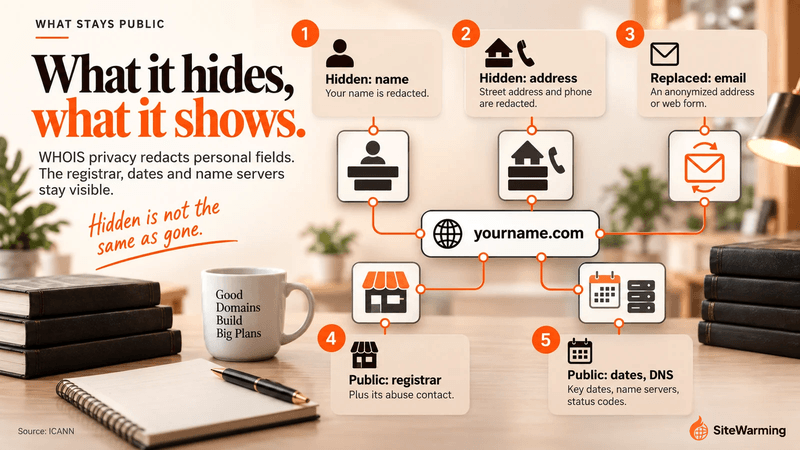
Annotated domain record showing which fields WHOIS privacy hides, such as name, address and phone, and which stay public, such as registrar, dates and name servers
WHOIS privacy replaces your name, address, phone number and email in a domain's public record with redacted or proxy details. Most major registrars now include it free, and ICANN's current policy redacts personal data where law requires it. Paid protection tiers are worth considering for change alerts and recovery safeguards, not for privacy alone.
Picture your renewal notice. The domain is $12. Below it sits another line item: Privacy Protection, $9.99.
You've paid it for three years. You're not sure what it does, only that it sounds important, so you pay it again.
Then, out of curiosity, you look your domain up in a public lookup tool. You type the name and hit search. Depending on the extension and the registrar, the record is half hidden. Some fields say "redacted," some show a proxy company's name, and a few things you expected to be private are not.
Now you're asking three questions at once. Is the fee redundant? What is it actually hiding? And if a buyer or partner looked you up, how would they reach you?
The product name promises more than the product delivers, which is why the confusion is so easy to fall into. This guide answers all three questions using what registrars, ICANN and the lookup record itself say as of October 2026.
What is WHOIS privacy?
WHOIS is the public record of who registered a domain. ICANN's contract with registrars requires every registrant to provide accurate contact details: name, address, phone number and email. ICANN, the nonprofit that coordinates the domain name system, accredits registrars and sets those rules.
For most of the internet's history, that record was open to anyone. It was built for network administrators who needed to report abuse or reach a domain's technical contact. It also became a harvesting target. ICANN's Security and Stability Advisory Committee studied the problem in 2007 and concluded that "the appearance of email addresses in responses to WHOIS queries virtually assures spam will be delivered to these email addresses" (SAC 023).
WHOIS privacy exists to break that link. Your details end up hidden in one of two ways:
- Redaction. The registrar marks personal fields as redacted in the public record.
- Proxy substitution. A privacy partner's details replace yours. GoDaddy's help page says eligible domains have "the Registrant contact info automatically replaced with substitute details from our privacy partner, Domains By Proxy."
Either way, anyone who looks up the domain sees placeholder data in place of yours.
One naming note. People still say "WHOIS" out of habit, but ICANN announced that as of January 28, 2025, the Registration Data Access Protocol (RDAP) is the definitive source for generic top-level domain (gTLD) registration data, such as .com, .net and .org, in place of the sunsetted WHOIS service. ICANN's own lookup tool runs on RDAP. This guide keeps the word WHOIS because that is what readers search for.
What did GDPR and ICANN change about WHOIS?
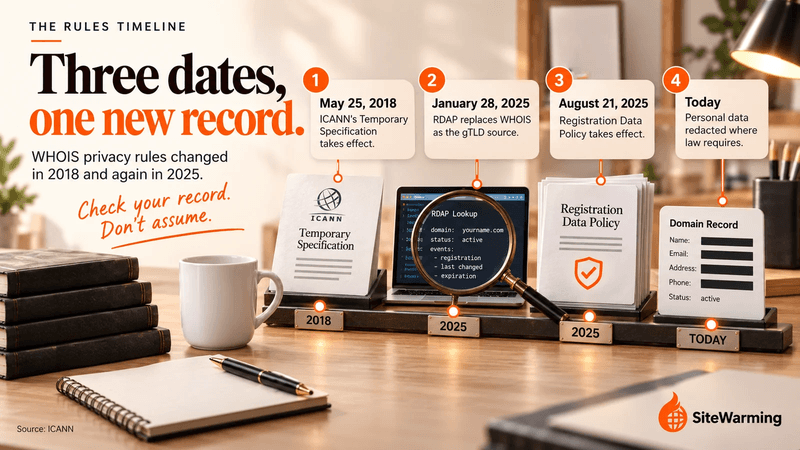
The General Data Protection Regulation (GDPR) is the EU's data protection law. Enforcement began on May 25, 2018, and ICANN's Temporary Specification for gTLD Registration Data took effect that same day. It restricted what registrars and registries publish, so personal fields such as the registrant's name, street address, phone number and email stopped appearing in public records unless the registrant consented.
On August 21, 2025, ICANN's Registration Data Policy took effect and replaced the Temporary Specification. Two details in it matter more than the headline.
Redaction is required where law requires it. ICANN's policy FAQ says redaction of registration data is mandatory only when it is needed to comply with applicable law.
Registrars don't have to separate people from companies. ICANN's June 2018 briefing says contracted parties are not required to differentiate between registrations from natural persons and legal persons. That leaves registrars free to apply redaction to every registration, and many do.
So "GDPR hides everything" is not quite right, and neither is "every registrar is legally forced to hide your data." The accurate version is that ICANN's policy requires redaction where law demands it and gives registrars room to go further.
One exception to watch. If you register under a company name, the Organization field is treated separately. ICANN's FAQ says a registrar may redact the Organization value if the registrant does not agree to publish it, so a company name can stay visible.
The practical conclusion: your record may already be hidden whether or not you paid anything. Check the record instead of assuming.
Is WHOIS privacy free? Which registrars include it?
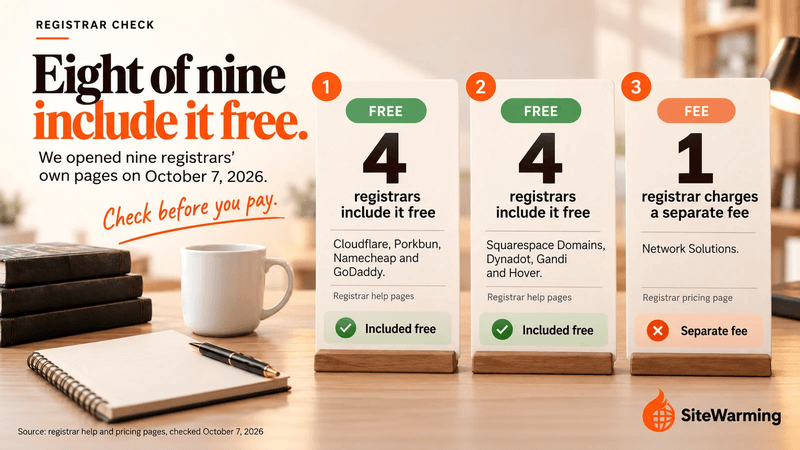
At most large registrars, yes. We opened each registrar's own help or pricing page on October 7, 2026. Eight of the nine include basic WHOIS privacy at no extra charge for eligible domains.
| Registrar | Basic WHOIS privacy | Condition | Source |
|---|---|---|---|
| Cloudflare Registrar | Free | Redaction that "meets current ICANN guidelines" | Cloudflare Docs |
| Porkbun | Free | Applies to participating domains | Porkbun |
| Namecheap | Free for life | With a new registration or transfer. Not offered on some extensions, including .uk, .de, .ca and .eu | Namecheap |
| GoDaddy | Free | Eligible domains. Paid tiers are now named Full and Ultimate Domain Protection | GoDaddy |
| Squarespace Domains | Free | Eligible domains | Squarespace |
| Dynadot | Free | Every eligible registration or transfer | Dynadot |
| Gandi | Free | Automatic | Gandi docs |
| Hover | Free | Eligible domains | Hover |
| Network Solutions | Separate fee | No price shown on its product page when we checked | Network Solutions |
Register.com's private-registration page redirects to the Network Solutions page. Prices and eligibility change, so read this table as a snapshot, not a quote.
If you still see a privacy line on your bill, one of three things is usually behind it: an older paid plan you never canceled, an extension where free privacy isn't offered, or a paid protection tier that bundles privacy with other features.
Here is how to find out which. Open your last three invoices and look for a line named privacy, private registration or protection. Then ask your registrar whether the domain qualifies for free privacy and what, if anything, the paid tier adds. If you're thinking about moving a domain to avoid the fee, compare the new registrar's transfer price and its renewal price, not just the privacy line. The registrar comparison covers renewal pricing and transfer policies, and why renewals cost more explains the gap between first-year and renewal prices.
What does WHOIS privacy hide, and what stays public?
Privacy does real work. It is not a scam in the sense of doing nothing. It becomes a bad deal only when you pay a separate fee for something your registrar already includes.
| Field in the public record | With WHOIS privacy or redaction |
|---|---|
| Registrant name | Redacted or replaced with proxy details |
| Street address and phone number | Redacted or replaced with proxy details |
| Replaced with an anonymized address or a web form | |
| Organization | May stay visible if you do not agree to publish it |
| Country, state or province | Can remain visible |
| Registrar name and abuse contact | Public |
| Creation, expiry and last-updated dates | Public |
| Name servers | Public |
| Status codes (locks) | Public |
Sources: ICANN's RDAP Response Profile, Registration Data Policy and policy FAQ.
The email row is where owners get tripped up. ICANN's FAQ allows either an anonymized email address or a web form. A web form lets a visitor message you through the registrar without learning your address. If a .com record shows your personal email in the open, that is worth a support ticket to your registrar.
Country-code extensions follow their own registry rules, and Namecheap lists .uk, .de, .ca and .eu among the extensions where it does not offer privacy.
Can anyone still see your real details?
Privacy hides your details from the public. It does not hide them from your registrar, and it does not release you from your obligations.
- You must keep the data accurate. ICANN's registrar contract says failing to respond for more than 15 days to a registrar's inquiry about the accuracy of your contact details is a basis for suspension or cancellation. Registrars also verify contact details within 15 calendar days of a change.
- You will be reminded. The Registration Data Reminder Policy requires registrars to show you your registration data at least annually and remind you that false contact information can be grounds for cancellation.
- Others can ask for nonpublic data. ICANN points people with a legitimate need to its Registration Data Request Service, and the registrar decides what to release.
- A proxy does not shield you from liability. Under section 3.7.7.3 of the same contract, a registrant who licenses a name to a third party accepts liability for harm caused by its wrongful use, unless it discloses the licensee's identity and current contact information within seven days to a party that provides reasonable evidence of actionable harm.
The short version: privacy means the public cannot see your address. It does not mean no one can. If you are on the other side of the lookup and need to find a domain's owner, this guide to finding the owner of a domain covers what to do when the record is redacted.
Does WHOIS privacy affect SEO?
No. When Google's John Mueller was asked whether domain privacy affects rankings, he answered with one word: "No." (as reported by Search Engine Journal). Turn privacy on or off for your own reasons, not for search.
What stays visible even with WHOIS privacy?
Privacy covers your contact record. Several other things remain visible whatever your settings.
- DNS records. Your name servers, mail routing (MX) records and IP address (A) records are public. Anyone can run a DNS lookup and see where your domain points.
- Certificate transparency logs. RFC 9162 describes certificate transparency as publicly logging the existence of TLS server certificates as they are issued or observed. A certificate names the hostnames it covers, so the subdomains you secure can show up in those logs.
- Historical WHOIS data. Commercial services such as DomainTools archive past WHOIS snapshots, so details exposed before you turned privacy on may still be retrievable. Privacy going forward does not scrub what was already public.
- Dates and registrar. The registration date, expiry date and your registrar's name are part of the public record.
Your name and address are hidden from casual lookup. Your domain's technical footprint is not. For most owners that is a reasonable trade.
What is domain protection, and is it worth paying for?
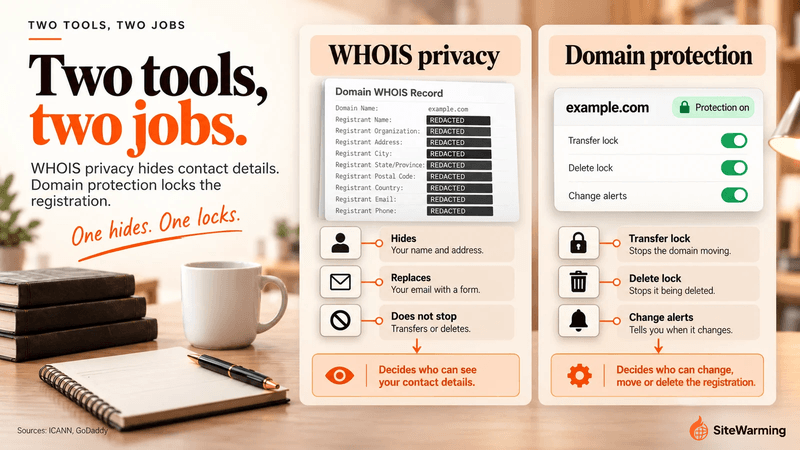
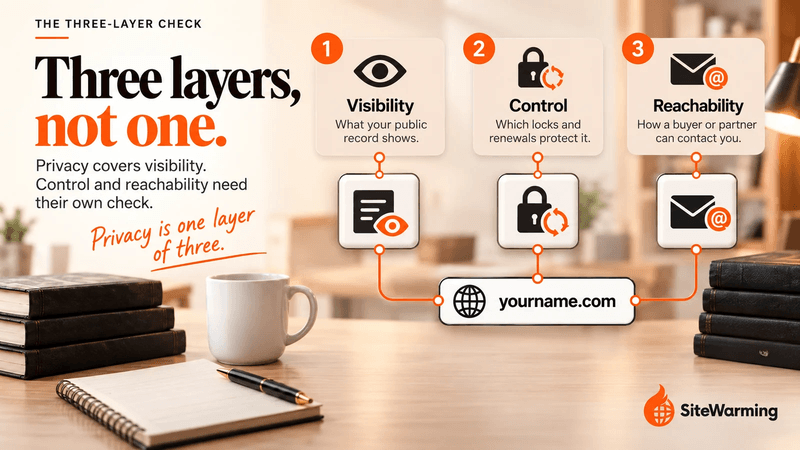
WHOIS privacy controls who can see your contact data. Domain protection controls who can change, move or delete the registration. They solve different problems, and registrars often sell them under similar names.
The protections run on registration status codes that ICANN lists on its EPP status codes page:
| Status code | What it tells the registry | Set by |
|---|---|---|
| clientTransferProhibited | Reject requests to transfer the domain to another registrar | Your registrar |
| clientDeleteProhibited | Reject requests to delete the domain | Your registrar |
| clientUpdateProhibited | Reject requests to update the domain | Your registrar |
| serverTransferProhibited | Prevent the domain from being transferred | The registry |
ICANN notes that server status codes take precedence over client codes. Some registries also offer a registry lock through registrars. Verisign says its Registry Lock Service helps keep .com, .net, .cc and .name domains from being hijacked, and it is available through participating registrars.
Paid tiers sit on top of those locks. GoDaddy's domain protection page describes a Full tier with change notifications, transfer and expiry safeguards and a 90-day renewal window, and an Ultimate tier that adds a further 90-day grace period and no recovery fees. The page shows no price, so compare at checkout.
Before you pay for any tier, check three things:
- Which locks already appear in your domain's status codes?
- Does the tier send alerts you would actually act on?
- Does it extend recovery beyond what your registrar already offers?
A domain that carries revenue, customer email or a brand is where one unauthorized transfer or one missed renewal costs more than the add-on. For undeveloped names, the cheaper controls are a registrar lock, a calendar of expiry dates and one view of every renewal. For how locks interact with transfers, see can a registrar hold your domain hostage and the transfer walkthrough.
Does WHOIS privacy make it harder for buyers to reach you?
It can. Privacy hides your name, and it also hides the person a buyer or partner would write to. What they find instead is a registrar's web form or an anonymized email address. That is a route. It is not a signal that anyone will answer.
If you hold names because you may want to sell, partner on or build them, that matters. The value of an unbuilt domain is the option to act when someone asks, and an inquiry that goes nowhere is an option you never exercised. Privacy was meant to keep your home address and phone number off the internet. It was never meant to keep serious inquiries away.
Keep privacy on and close the gap in three steps:
- Confirm the anonymized email or web form on your record forwards to an inbox you read.
- Publish a contact path on the domain itself, so a visitor does not depend on a registrar form. An open, reachable domain does not need to be listed for sale to receive an offer.
- Learn what real interest in a domain looks like so you notice it when it arrives.
This is the gap SiteWarming's Launch & Warm closes: content on the domain makes it findable, and a contact path means the option to sell, partner or build can be exercised when the moment comes.
How do you check what your WHOIS record shows?
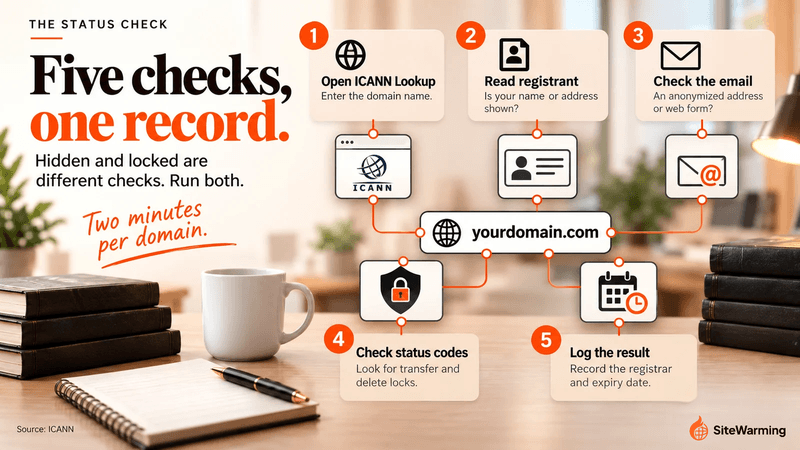
Check every domain you care about, not just the main one. It takes about two minutes per name.
- Open ICANN Lookup and enter the domain name.
- Read the registrant fields. Redacted fields are marked as redacted, or show a proxy company's details.
- Read the contact email field. You want an anonymized address or a web form, not your personal address.
- Read the status codes. Look for clientTransferProhibited, and compare them with the ICANN list.
- Note the registrar, the expiry date and the registrar's abuse contact, then log the result for each domain.
If you hold more than a few names, add privacy, lock and expiry columns to your domain portfolio template. Country-code extensions may show different fields because their registries set their own rules.
Should you pay for WHOIS privacy?
| Your situation | What to do |
|---|---|
| Your registrar includes privacy free | Confirm it is on in the lookup and pay nothing |
| You pay a separate privacy line item | Ask whether the domain qualifies for free privacy, and compare transfer and renewal prices before moving |
| Your extension does not support privacy | Check the registry's rules and keep your registrar contact details accurate |
| You register under a company name | Decide whether the Organization field should be public |
| The domain carries revenue, email or a brand | Consider a protection tier, and ask about a registry lock |
| You hold undeveloped names | Keep privacy and locks on, track every expiry date and give each name a contact path |
Is WHOIS privacy a scam?
No. It does what it says: it replaces your contact details in the public record. The scams sit around it.
One is the fee for something already included. The other is the fake notice. Unsolicited emails that offer to renew your domain or your privacy plan are a long-running fraud pattern, and ICANN has warned about it: "Be careful what you click. Be suspicious of any email that offers domain renewal services from ICANN. As a reminder, ICANN does not process domain registrations or collect fees from registrants directly." The renewal email scam check shows how to confirm a notice is from your actual registrar before you pay.
The broader point is something trust is a system explores in full. Digital trust isn't one product you buy once. It is a set of independent layers, and knowing which layer each product protects is how you avoid paying for the same layer twice. Your privacy in the record is one layer. Your actual claim on the domain is another, and whether you really own your domain is a different question. Both matter, and they are not the same thing.
If you hold names across several registrars, each one shows a different record, a different fee and a different lock. SiteWarming's domain renewal tool puts every domain across every registrar in one view, so the expiry dates are the one thing you no longer have to chase. The multi-registrar management guide covers the rest.
Related reading
- Best Domain Registrars for Long-Term Ownership in 2026: renewal pricing, transfer policies and which registrars treat privacy as a baseline.
- Domain registrar vs. web host: why registration and hosting belong at different companies.
- The domain renewal email scam check: how to verify a notice before you pay.
- Do you own your domain?: what registration gives you and what it does not.
- Can a registrar hold your domain hostage?: locks, transfer denials and your options.
- Open, not listed: a reachable domain: how a domain can receive offers without a for-sale sign.
Frequently asked questions
Is WHOIS privacy worth it?
For most owners, yes, but you should not pay a separate fee for it. Eight of the nine registrars we checked include basic WHOIS privacy free for eligible domains. It keeps your name, address and phone number out of the public record. Paid protection tiers are a separate decision, and they add change alerts and recovery safeguards.
What does WHOIS privacy hide?
It redacts or replaces your name, street address, phone number and email in the public record. Your email is swapped for an anonymized address or a web form. The registrar, creation and expiry dates, name servers and status codes stay public, and country or state fields can remain visible.
Is WHOIS privacy free?
At most large registrars it is. Cloudflare, Porkbun, Namecheap, GoDaddy, Squarespace Domains, Dynadot, Gandi and Hover each say on their own pages that basic privacy is included for eligible domains. Network Solutions charges a separate fee. Some extensions, such as .uk, .de, .ca and .eu at Namecheap, are not covered.
Can someone still find my name with WHOIS privacy on?
Not from the current public record, but older data may exist. Commercial services such as DomainTools archive past WHOIS snapshots, so details exposed before you turned privacy on can still be retrievable. Your registrar also holds your real details and can release them in response to a request that meets its disclosure rules.
Does WHOIS privacy affect SEO?
No. Google's John Mueller answered "No" when asked whether domain privacy affects rankings, as reported by Search Engine Journal. Turning privacy on or off has no ranking effect, so decide based on what you want the public to see.
What is the difference between WHOIS privacy and domain protection?
WHOIS privacy hides your contact details from the public. Domain protection controls who can change, move or delete the registration, through locks such as clientTransferProhibited and clientDeleteProhibited, plus change alerts and recovery features at some registrars. A domain can have one without the other.
How do I check whether my WHOIS data is hidden?
Enter the domain at ICANN Lookup and read the registrant fields. Redacted fields are marked, and your email should appear as an anonymized address or a web form. Check the status codes for a transfer lock, and note the registrar and the expiry date.
Does WHOIS privacy make it harder for buyers to contact me?
It can. A buyer sees a redacted record and a registrar web form or anonymized email, not your details. Confirm the form forwards to an inbox you read, and publish a contact path on the domain itself so interested buyers do not depend on the registrar.
Is WHOIS privacy a scam?
No. It does what it says. The problems are paying a separate fee for what your registrar already includes, and fake renewal notices that offer to renew your domain or privacy plan. ICANN says it does not collect fees from registrants directly, so verify any notice with your registrar before paying.
Share this article
Ready to Transform Your Domain Portfolio?
Start building real value with your domain investments today.