A Domain Locker Alternative: A Simpler Way to Manage and Launch Your Domains
 Bret Siers
It's late. You have two tabs open, and you're comparing them line by line.
You've been meaning to get your domains in order for months. Maybe you own twenty of them. Maybe fifty. They're scattered across a few registrars, half of them you forgot you owned, and every so often a renewal email arrives to remind you that the idea behind one of them still matters. So tonight you finally started looking. One tab is Domain Locker. The other might be a spreadsheet you gave up on.
The quiet question sitting under all of it is simple. Which of these is actually for someone like me?
Here's the honest answer, up front, before I position anything. Domain Locker is an open source, actively maintained monitoring platform. It watches the things that change underneath a domain, SSL, DNS, WHOIS, uptime, and it alerts you when they do. SiteWarming is for something else. It's for owners who want one calm view of everything they own and a way to keep the idea alive. Those are two different jobs. If this page helps you figure out which job is yours, it did its work, even if you close the tab on SiteWarming.
Is there a simpler Domain Locker alternative?
Yes, and here's the clean split, no hedging. Domain Locker watches the infrastructure. SiteWarming keeps the idea alive. Watch the infrastructure, or keep the idea alive. That's the whole fork.
If you want to watch your domains closely, the way you'd keep an eye on a piece of equipment you depend on, that's what Domain Locker is built to do. It tracks SSL, DNS, WHOIS, and uptime, and it alerts you when any of them change. If that's your need, you could close this tab right now and go use it, and I'd think you made a good call.
But most people reading a page like this at midnight aren't asking a monitoring question. They're asking a quieter one, and to answer it honestly, we have to talk about something that has nothing to do with which tool has more settings.
Domain monitoring vs keeping the idea alive: two different jobs
Here's the thing no feature comparison will tell you. The reason these two tools feel so different isn't the checkbox lists. It's that they're built for two different kinds of owner. There are really just two. Infrastructure owners, and idea owners.
An infrastructure owner watches their domains like infrastructure, things that sit underneath something live and can quietly break. For that owner, the job is watching. Is the certificate still valid? Did a record change? Is anything about to expire out from under me? That's a real job, and it deserves a real tool. When something shifts, they want to know the instant it happens. Domain Locker is built for exactly this job: SSL, DNS, WHOIS, and uptime tracking, with alerts the moment something changes.
An idea owner isn't watching infrastructure at all. They own ideas.
Think about how you actually got these domains. You didn't buy a server to watch. You bought a possible future. One was going to be a side project. One came to you on a trip, and you registered it before you lost the name. A few you can't fully explain anymore, but you keep renewing them, because letting go feels like giving up on something that might still matter. Each one was a small bet on a version of your life that hasn't happened yet.
That owner isn't watching for something to break. Nothing is running. There's no uptime to guard, no certificate to renew in anger. What that owner is quietly afraid of is different, and heavier. Not that a domain will go down. That the idea will go cold. That the future they paid for will slip past unnoticed, in the dark, while they meant to get to it.
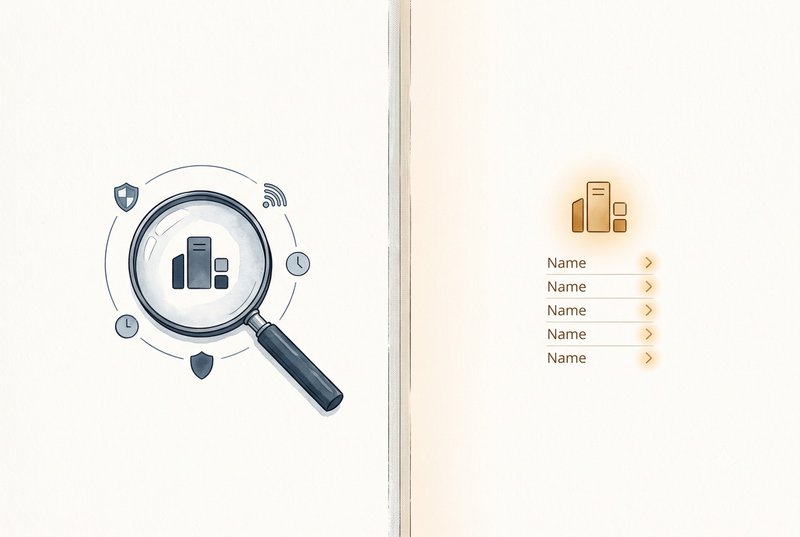
Two jobs, one domain: watch the infrastructure (left) or keep the idea alive (right).
So the honest split isn't about features at all. It's about what you own and what you're afraid of losing. If you own infrastructure and you're afraid something will break, you want to monitor. If you own ideas and you're afraid one will go cold, you don't need a better alarm. You need a way to keep the idea alive and keep your options open until the moment is right.
That's the whole comparison, said plainly.
What an idea-buyer actually needs
If you're an idea owner, the person who bought a future and then went quiet, then your first need was never more monitoring. It's one view.
Every domain you own, across every registrar, in one place, so you can finally see the whole set instead of five logins and a stale spreadsheet. That's the first thing SiteWarming does, and it has a plain name: Manage. Just seeing them together is the moment most of the weight lifts, because the weight was never really about SSL or DNS. It was about not being able to hold the whole thing in your head at once. You can manage domains across multiple registrars from one dashboard.
Then comes the part that watching can't give you, because watching guards, it doesn't keep anything alive. Once you can see everything, you can choose which of these ideas you want to make findable. That's Launch. Launch makes a domain visible, with an anonymous contact path, so the right person can discover it and reach you. Open, not listed. Reachable to opportunity without turning you into a seller or putting anything up for bids. You're not selling the idea. You're keeping it alive, and keeping the door open, so that if the right moment or the right person arrives, they can find their way in instead of moving on while you never even knew they came.
That's a different relationship to a domain than watching it. A monitoring platform treats a domain as something to guard against loss. This treats it as something to keep warm and keep open, an idea kept alive rather than a line in a list. If you're wondering why your registrar's own screen can't already give you that one view, that's its own honest question, answered here: portfolio tool vs registrar dashboard.
The SiteWarming perspective
If you want deep monitoring, watching your domains closely and knowing the instant something changes underneath them, Domain Locker is the right pick. If you want one view of everything you own and a way to keep those ideas alive and your options open, that's the job SiteWarming exists for. See what is SiteWarming.
So which one is for you?
There's no winner here. There's a fork, and you're standing at it.
If you close both tabs tonight thinking, I want to keep a careful eye on these and know the moment anything about them changes, then Domain Locker earned that. Go with a clear conscience.
If instead you're thinking, I just want to see everything I own in one place and finally keep these ideas from going cold, then that's SiteWarming, and it's the simpler road for that particular need.
Watch the infrastructure, or keep the idea alive. That's really the only question, and you already know your answer, because you already know what you were afraid of when you opened these tabs. Either way, you're the one in control. Nobody's rushing you. Close the tabs, sleep on it, and pick the one that fits the person you actually are.
Photo by Clint Patterson on Unsplash
Share this article
Ready to Transform Your Domain Portfolio?
Start building real value with your domain investments today.