Domain Strategy for Niche Businesses: How to Choose, Activate, and Own Your Corner
 Bret Siers
Someone registered the perfect domain five years ago. Exact match. The name said exactly what the site was about. They paid the registration fee, told themselves they'd build something on it soon, and then life kept moving.
The domain sat dark.
Two years ago, a competitor registered something different. A brandable name. Short, memorable, vaguely evocative of the topic. Not immediately obvious what it covered. But they started warming it. Structured content. Consistent publishing. A clear story about who the site was for.
Within 18 months, the brandable domain was indexed across the topic. When people in the niche searched for answers, it showed up. When AI systems were asked about the topic, it was cited.
The exact-match domain is still invisible.
The lesson isn't that exact-match domains are bad. The lesson is that a domain's strategy isn't determined by its name. It's determined by what happens after you register it.
Why Generic Domain Advice Fails for Niche Information Businesses
Most domain strategy content is written for e-commerce brands. Be short. Be memorable. Get the .com. Avoid hyphens. Make sure people can spell it after hearing it once.
That advice is fine for its context. It doesn't translate to yours.
An e-commerce brand needs to survive a "spell it from memory" test because customers will be typing the URL directly. A niche information business gets most of its discovery through search and referral within the niche community. The domain needs to communicate trust and specificity, not pass a spelling test.
Your community will link to you. They'll share specific article URLs. They'll say "the people at [domain name] cover this topic." The domain name is a signal to the community, not primarily a navigation tool.
The three decisions that actually matter for niche information businesses are different from what generic advice covers.
The Three Domain Type Decisions
Exact-Match vs Brandable vs Community-Name
Exact-match domains include the specific topic keywords directly. If you cover synthetic biology instrumentation, an exact-match domain might be synbio-instruments.com. If you cover Charlotte local government news, it might be charlottecityhall.com.
The strength: immediately communicates specificity. Someone in the niche sees the domain and knows what it covers. Trust transfer happens quickly for people looking for exactly that topic.
The weakness: limits future scope, can feel clinical rather than authoritative, and highly specific exact-match domains are often taken already. If you decide to expand your niche coverage later, the domain may feel constraining.
Brandable domains are invented or metaphorical. They communicate a feeling or identity rather than a direct topic description. The Charlotte Ledger is a brandable domain. "Ledger" signals journalism, record-keeping, accountability, without naming the specific coverage topic.
The strength: flexibility, memorability, and the ability to build a distinct identity that isn't tied to a specific topic phrase. Brandable domains often earn more community attachment than exact-match ones because they feel like a publication name rather than a search term.
The weakness: requires more work to establish what the domain covers. The context has to come from the content, not the name.
Community-name domains use the name the community uses for itself. If there's a well-known conference, a commonly used abbreviation, or a phrase the community has adopted for their professional identity, building a domain around that vocabulary can create instant recognition and belonging signals.
The risk: you don't own the community's vocabulary. If the community evolves, or if the shared vocabulary already has a home, the community-name strategy may not work.
For most niche information businesses starting from scratch, a brandable domain that evokes the right feeling for the specific audience is the strongest choice. It creates space for depth without being limited by keyword specificity, and it builds a distinct identity rather than a searchable phrase.
But whichever type you choose, there's a second question people get stuck on.

The .com Question
Here's the clear position: .com is still the default recommendation for a niche information business. The case for alternatives requires a specific reason.
.com commands premium resale value and default trust in most audience surveys. When someone receives a link from an unfamiliar domain, .com still gets more initial benefit of the doubt than .net, .io, .co, or newer extensions. That default trust matters most when your audience is encountering you for the first time.
The case for alternatives is real in specific circumstances:
.io has earned genuine credibility in technology and software communities. If your niche is technical and your audience is developers or tech-adjacent professionals, .io doesn't carry a trust penalty. It may even signal community membership.
.org carries authority signals in nonprofit, academic, and community-organized contexts. If your niche site serves a professional community and operates as a nonprofit or community resource, .org can strengthen trust.
.news, .media, .press have emerged as credible extensions for journalism-specific contexts. For niche news publications, these extensions now communicate editorial intent rather than novelty.
Honestly, the extension matters less than most domain advice implies. What matters is what happens after you choose it.
The general rule: choose an alternative extension when it carries positive meaning in your specific niche community, not as a workaround because the .com was taken. A domain with a meaningful extension is better than a compromised .com with hyphens or added words that dilute the name.
If the .com you want is taken and for sale, the premium is often worth it. A strong .com acquired early, even at some premium, is a long-term strategic asset in a way that a compromised name isn't. But don't let the perfect name become a reason to delay what actually matters: building on whatever name you have.
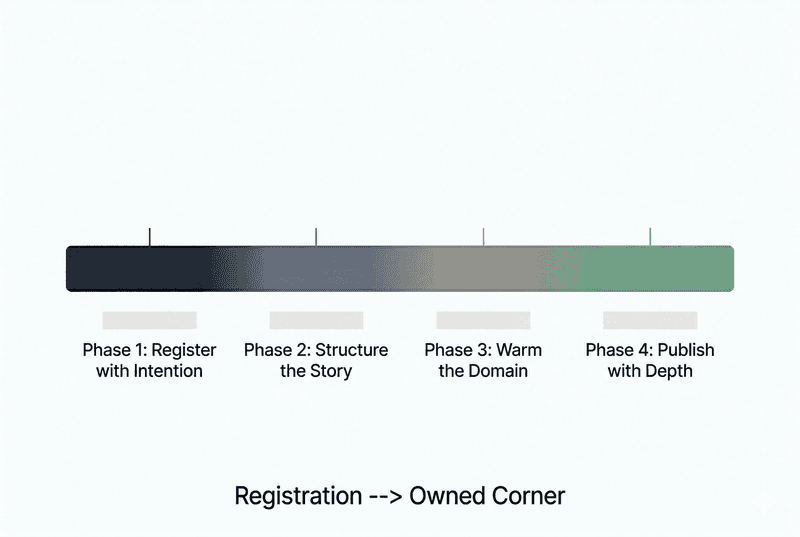
The Four Phases from Chosen Domain to Owned Corner
This is the part most domain advice skips entirely. Choosing the domain is the beginning of the strategy, not the end. If you're managing more than one domain, building a domain roadmap covers the broader framework. For a single niche business, here's what comes next.
Phase 1: Register with intention. When you register, immediately redirect the domain to a simple holding page that says what the site is about and who it's for. Not "coming soon." A one-paragraph description that tells a visitor exactly what this place will cover. This takes 30 minutes and immediately starts creating a signal that the domain is occupied with purpose.
Phase 2: Structure the story. Before you publish anything people will read, structure the domain's story. What are the core topics you'll cover? What vocabulary does your audience use? What's the one thing you'll be more thorough on than anyone else? The structure doesn't need to be visible on the page, but it needs to be in your head before the first article goes up. Publishing without a clear structure produces a scattered archive that doesn't compound.
Phase 3: Activate the domain. This is the phase where the domain goes from "registered with intention" to "actively discoverable." Structured content. Consistent signals. A publishing rhythm that search systems and human readers can learn to expect. An active domain has indexed content, an established topic association, and a visible presence that tells anyone who finds it: this is a real place, this is what it covers, this is who it's for.
A domain with 6+ months of indexed content has accumulated signals that a freshly registered competitor cannot shortcut. That head start is the competitive advantage of getting started now rather than later. Domains are infrastructure, not lottery tickets. The infrastructure value is built over time, not at registration.
Phase 4: Publish with depth. Once the domain is active, the publishing strategy becomes about deepening the authority signal. Fewer, more comprehensive pieces that fully answer the most important questions in your niche. The depth compounds over time in ways that volume doesn't.
What Warming Looks Like at the Domain Strategy Level
Here's the truth nobody tells you about domain strategy. Warming is the phase that makes the domain decision matter. Everything before it is just a name. Everything after it is the actual strategy.
A perfectly chosen domain that sits dark is worth no more than a randomly chosen one. A mediocre domain name that's been warmed consistently for 12 months is worth more than a perfect name that launched yesterday.
From ownership to stewardship is the mindset shift that makes this work. You're not just holding an asset. You're actively building something on it over time. The domain becomes the home for a specific community, a specific topic, a specific set of ideas. That home is what converts visitors into subscribers and subscribers into community members.
Both the name and the warming matter. But if you have to choose which one to invest more care in, invest it in the warming. Every time.
A mediocre name, warmed well, in a niche nobody else is covering, beats a perfect name sitting dark. Visibility before validation is the principle: make the domain findable first, then let the audience prove the niche is real.
What SiteWarming is covers the warming process in detail. And if you're still evaluating whether your niche idea has legs, validating a niche idea before building anything covers the honest framework for testing that question.
The companion piece, how to monetize a niche website without ads, covers what comes after the domain is active and the audience has started to build.

The SiteWarming perspectiveEvery domain strategy decision, name type, extension, timing, ultimately gets evaluated by one question: is this domain visible to the people who would benefit from finding it? Registration gets you the address. Warming builds the presence. Without the warming phase, the best domain name in the world is still invisible to the community it was meant to serve. What is SiteWarming?
Image Credits
- Hero: Photo by Izabela Mierzejewski on Unsplash
Share this article
Ready to Transform Your Domain Portfolio?
Start building real value with your domain investments today.